Provides event-loop timers. More...
#include <net/timers/timers.hpp>
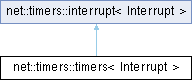
Public Types | |
| using | interrupt_type = interrupt< Interrupt > |
| The base interrupt type. | |
 Public Types inherited from net::timers::interrupt< Interrupt > Public Types inherited from net::timers::interrupt< Interrupt > | |
| using | interrupt_source_t = Source |
| The underlying interrupt source type. | |
Public Member Functions | |
| timers ()=default | |
| Default constructor. | |
| timers (const timers &other)=delete | |
| Deleted copy constructor. | |
| timers (timers &&other) noexcept | |
| Move constructor. | |
| auto | operator= (const timers &other)=delete |
| Deleted copy assignment. | |
| auto | operator= (timers &&other) noexcept -> timers & |
| Move assignment. | |
| auto | add (timestamp when, handler_t handler, duration period=duration::zero()) -> timer_id |
| Add a new timer. | |
| template<class Rep , class Period > | |
| auto | add (std::chrono::duration< Rep, Period > when, handler_t handler, duration period=duration::zero()) -> timer_id |
Overloaded add function that uses a std::chrono::duration instead of a time_point for the first timeout. | |
| auto | add (std::uint64_t when, handler_t handler, std::uint64_t period=0) -> timer_id |
Overloaded add function that uses a uint64_t instead of a time_point for the first timeout and the period. | |
| auto | remove (timer_id tid) noexcept -> timer_id |
| Removes the timer with the given id. | |
| auto | resolve () -> duration |
| Resolves all expired event handles. | |
| ~timers ()=default | |
| Default destructor. | |
| Public Member Functions inherited from net::timers::interrupt< Interrupt > | |
| auto | operator() () const noexcept -> void |
| Calls the underlying interrupt. | |
Friends | |
| template<InterruptSource I> | |
| auto | swap (timers< I > &lhs, timers< I > &rhs) noexcept -> void |
| Swap function. | |
Detailed Description
class net::timers::timers< Interrupt >
Provides event-loop timers.
- Template Parameters
-
Interrupt An interrupt source that satisfies the InterruptSource concept.
timers is the spritual successor to cpptime and has been modified for integration with the cppnet context_thread event-loop. As such, it exposes the same API as a CppTime::Timer for adding and removing timers. Unlike a CppTime::Timer, timers does not execute the timer callbacks in a separate thread. Instead, to resolve the timer event callbacks an event loop must explicitly call the public resolve method. The resolve method return a std::chrono duration until the next event timeout. If there are no more events in the internal event queue, then the resolve method returns duration(-1), otherwise the returned duration contains a strictly non-negative count.
Member Function Documentation
◆ add() [1/3]
| auto net::timers::timers< Interrupt >::add | ( | std::chrono::duration< Rep, Period > | when, |
| handler_t | handler, | ||
| duration | period = duration::zero() |
||
| ) | -> timer_id |
Overloaded add function that uses a std::chrono::duration instead of a time_point for the first timeout.
- Template Parameters
-
Rep The arithmetic tick type for a std::chrono::duration.Period The std::ratioof astd::chrono::duration.
- Parameters
-
when The time until the timer times out. handler The timer event handler. period The time between events for a periodic timer.
- Returns
- The id associated with this timer.
◆ add() [2/3]
| auto net::timers::timers< Interrupt >::add | ( | std::uint64_t | when, |
| handler_t | handler, | ||
| std::uint64_t | period = 0 |
||
| ) | -> timer_id |
Overloaded add function that uses a uint64_t instead of a time_point for the first timeout and the period.
- Parameters
-
when The number of microseconds until the event times out. handler The event handler. period The number of microseconds between events for a periodic timer.
- Returns
- The id associated with this timer.
◆ add() [3/3]
| auto net::timers::timers< Interrupt >::add | ( | timestamp | when, |
| handler_t | handler, | ||
| duration | period = duration::zero() |
||
| ) | -> timer_id |
Add a new timer.
- Parameters
-
when The time at which the handler is invoked. handler The callable that is invoked when the timer fires. period The periodicity at which the timer fires. Only used for periodic timers.
- Returns
- The id associated with this timer.
◆ remove()
|
noexcept |
Removes the timer with the given id.
- Parameters
-
tid The timer_id to remove.
- Returns
- tid if the timer is not valid. Otherwise returns INVALID_TIMER.
remove is designed to be used in a self-assignment statement. When the timer has been disarmed, the original timer_id will be cleared to an INVALID state. This minimizes the risk of calling remove on a timer twice.
◆ resolve()
| auto net::timers::timers< Interrupt >::resolve | ( | ) | -> duration |
Resolves all expired event handles.
- Returns
- The duration until the next event times out. Returns
duration(-1)if the internal eventq is empty.
The documentation for this class was generated from the following file:
- net/timers/timers.hpp